
#73 - On co-founders
philia in the journey of co-founders, one of the most important decisions for the company. A few suggestions on how to find and keep them. Note, some AI slop for images but never for writing.

(Renewed) Optimism in biotech
It has been unreasonably unseasonable in the Bay Area; warmer than forgotten years, magnolia blooms erupting in a vibrant, though mistimed, symphony. With a shifting and fulminant climate, the seasonal thaw from slumber proceeds ever, relentlessly. Such is the way of nature.
The metaphor of Spring holds true for many of our human endeavors. In the field of biotechnology, a winter of sclerotic investment, job layoffs and company shutdowns have weighed over the last few years. But things appear to be renewing.
Besides the surge of interest in GLP-1 agonists, which fueled Eli Lilly to become the first trillion dollar pharmaceutical company, the field has been receiving good news. Just this month, Revolution Medicine’s KRAS inhibitor, daraxonrasib, was shown to double overall survival in notoriously untreatable KRAS mutant pancreatic cancers. Nektar leveraged their immuno-oncology expertise and demonstrated a robust response of IL-2 towards treating genetic alopecia areta (hair loss), a field which has had little progress for decades. And a gene therapy for a corrected version of the auditory-related gene OTOF, whose development began in the late 1990s, has received an FDA nod after demonstrating significant restoration of hearing to deaf children.

Clinical progress sets the stage for robust mergers and acquisitions between biotech and pharma; indeed there have been seven separate billion dollar plus valued deals in less than two weeks in March. That capital precipitates and infuses into the investment soil, providing pivotal sustenance for promising, nascent companies to shoot through the lingering capital rimefrost.
I’ve come across several such companies over the last week. Amit Tal is developing a novel cell therapy delivery technology, inspired by fetal microchimerism at tex-tx, to help patients suffering from traumatic brain injury. Another company in Los Angeles, Proteopulse, is developing a rapid, high throughput multiplexed proteomics technology for clinical diagnostics.
As a reinvigorated investment climate converges with technical advances like automation, new analytical techniques and AI/ML, these new companies are poised to accelerate their development, unburdened by existing technical debt that weigh upon antiquated technologies. As they glance up the mountain towards progress, a new sun of a new biotechnology future peeks past the crags obscuring the horizon.
New companies have co-founders
Yes, great technology and robust financing are necessary for a biotechnology company to thrive. But they aren’t sufficient; advances and money have yet to address people and their relationships. I’m reminded of this in meeting co-founders on the verge of emergence, with a person or two with an idea, a post-doctoral research project, an app or patent application. Convincing others to have faith in this new company is a crucial skill set for a founder, especially when finding and recruiting co-founders.
I’m on the record as saying that I would never work on a company as a solo founder. That’s merely my take. Some might claim downsides: slower decision making, interpersonal conflict and decreased control and authority. But I find sharing the work load, enjoying the journey together, having someone to commiserate with and backstopping each other when life hits, more than makes up for this. I’ve found some of my best friends this way.
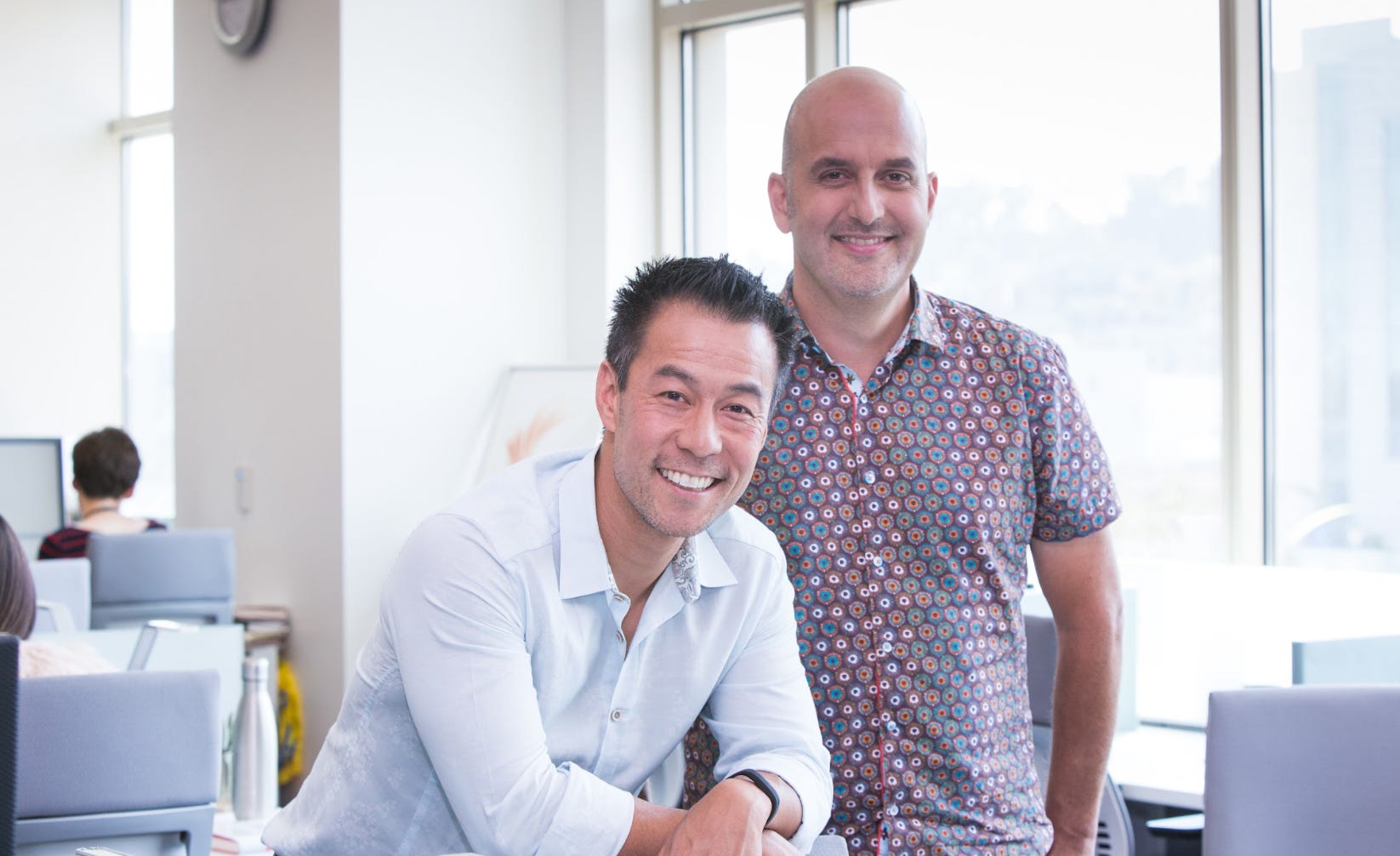
I’m not the only one who believes in partnership; many agree with me. After all co-founders often come together with functional complements; disparate skills and experiences which increase the company’s ability to retire broader aspects of risk. Sometimes the technologist meets the business developer, the doctor meets the marketer, the introvert meets the extrovert and the cofounding team is stronger for it.
But Cofounder Mode1 guru, Annie Garofalo, the long lost organizational behavior cousin of the relationships experts, the Gottmans, reminds us that 65% of companies fail because of relational issues in co-founder dynamics. These include disagreement over direction, resentment, pathological conflict and disempowerment - the usual stuff of any relationship. I’ve been fortunate(?) to witness this personally after mentoring, advising and observing a plethora of companies. I’ve had to help several to mediate some difficult conversations and eventual separations. And it devastates me to see promising products and technologies die on the vine due to poor curation and investment in these professional relationships.
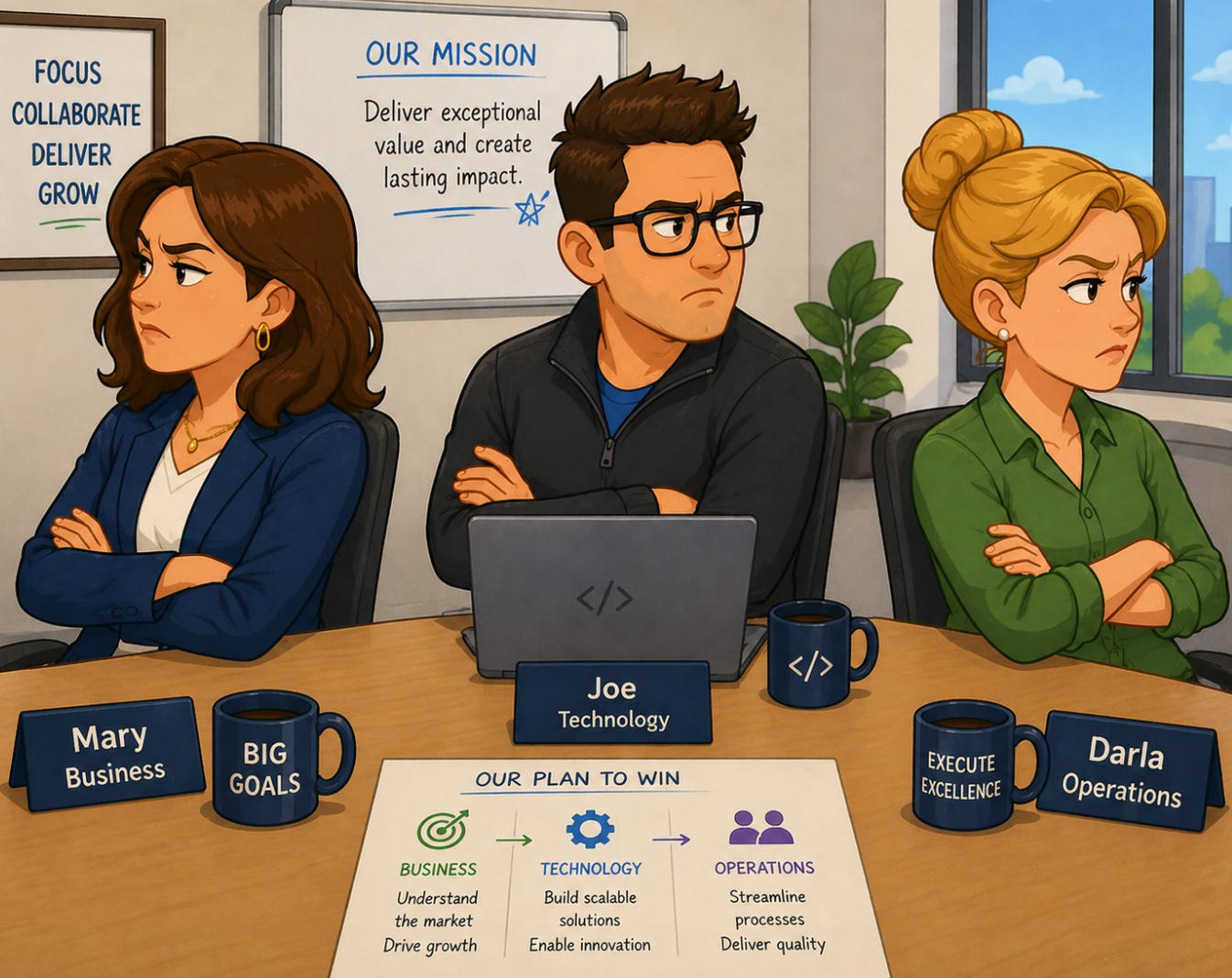
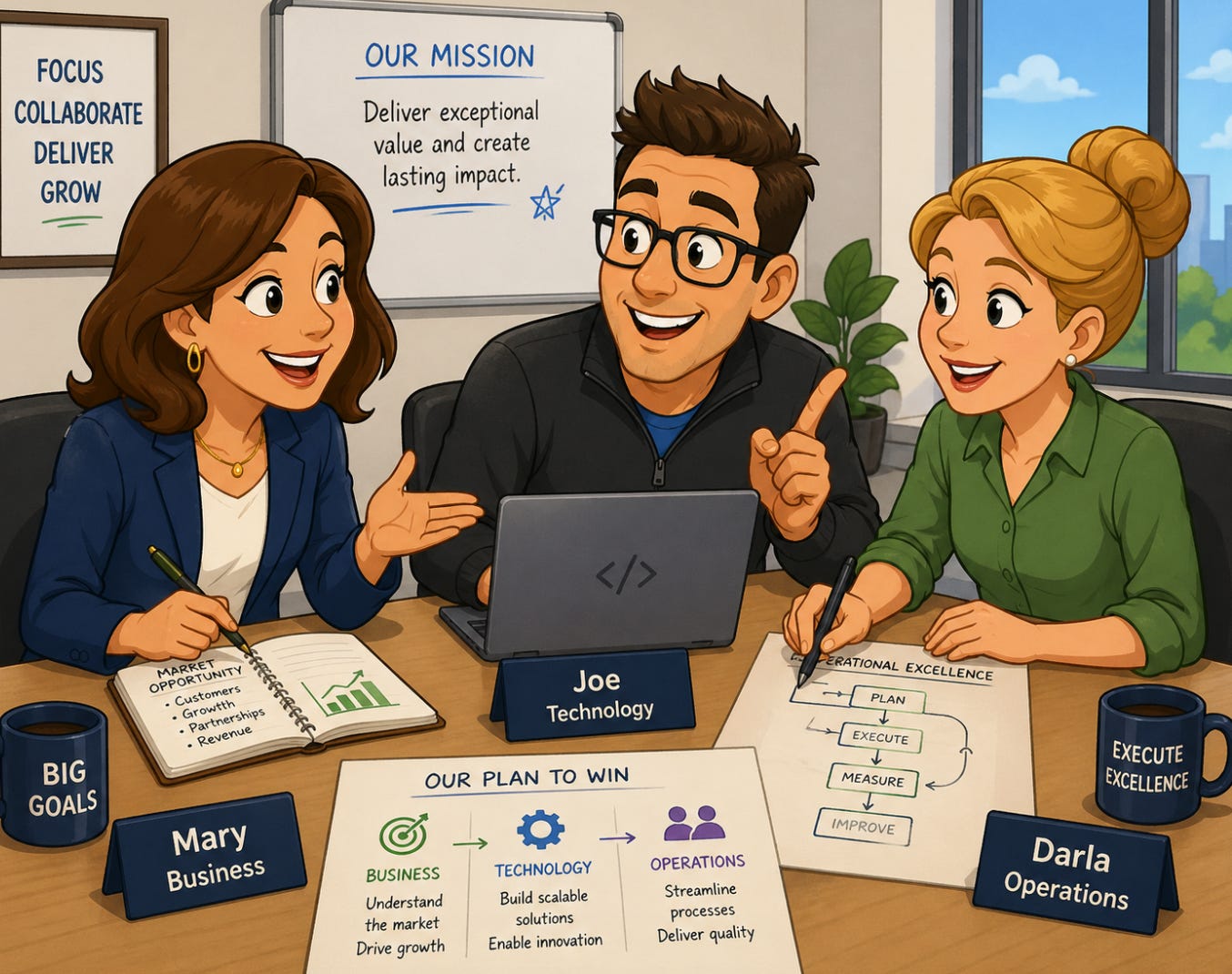
One of the key mistakes that occur in finding co-founders is the tendency to over bias on functional complementarity at the expense of understanding whether or not they can navigate a journey together. A founding team consisting of Mary Business, Joe Technology and Darla Operations might have Joe playing with technology, Darla demanding unrealistic budgets and Mary overpromising on a quick exit.
A founding team that makes central their commitment to solve an important problem will align and reinforce Mary, Joe and Darla as co-founders, who merely happen to possess different skill sets.
And it could be worse; there are those who pose as “co-founders” but are, in reality, predators armed with glossy resumes of past successes (often with minimal actual personal contributions) who promise access to their network, in exchange for an exorbitant amount of equity in the company. Avoid these people at all costs.
Finding and Affirming Co-Founders
Co-founders are so much more than what is indicated on the incorporation documents. They are likely to spend three, five, ten or more years together, solving problems, celebrating (temporary) wins and moving forward a shared future, envisioned.
At the end of the day, co-founders are very much like long term romantic relationships. And similar to a marriage, nurturing respect, attention and care for each other with shared values, empathetic conflict resolution and strong communication are necessary for success. But first, you gotta date.
So step one, how do we find and match with good co-founders?
Remember the diamond: as with recruiting any team mate, how have you determined whether or not there is alignment between your motivations and/or shared overlap in values?
Not sure how to figure this out? Ask open-ended questions like we’ve highlighted in this interview deck
Have a conversation with Annie’s Cofounder cards, asking questions like:
What is something people may misunderstand about you?
What feels like good compensation at different at different funding stages?
Discuss some of Arthur Aron’s 36 questions, which are useful to not only find and create love, but to reveal more of ourselves to one another. You can probably skip the part about staring into each other’s eyes.
Step two, how do you keep, build and nurture the good ones?
Founder stock: This one is somewhat controversial, but there are a lot data points that suggest this is important for a company’s, and co-founders’ relationships, longevity. One should aim for equal equity splits, or at least what everyone deems fair. Don’t nitpick on whether or not it was your idea or that you started the company 3 months ago as rationale to own 90% of the stock. Like investors, co-founders want each other to stick around for the long haul. Vastly different equity ownership becomes a point of contention, and ultimately a catalyst for fracture, when the going gets tough2.
Reaffirm the co-founder relationship by, once again, having a conversation with Annie’s Cofounder cards
Continue to learn about each other through rituals like hump gathering.
Invest in the relationship by doing things together that have nothing to do with work: dinner, drinks, escape rooms, book clubs and especially good personal talks. You’re not a co-founder; you’re a human being who happens to be a co-founder.
Lastly, democracy versus autocracy
I’ve been accused of being idealistic, overly optimistic or touchy-feely. I am. You’d expect me to advocate for teamwork and collaboration. I do.
But I can’t tell you how many difficulties have occurred when a company lacks a singular, consistent, authoritative voice.
I’ve encountered many teams who describe their decision process as democratic or through consensus. Sometimes they describe how each co-founder makes decisions within their fiefdoms of marketing, technology, or operations. Working this way empowers and endows agency to each co-founder.
In principle this is not a terrible approach, streamlining decisions, at least the majority of the time. But in the complex business of biotechnology, companies are rarely solely technology, market, finance or operations driven alone. Companies, especially at early stages, are suprafunctional structures. Each of the constitutive functions’ needs and goals often exist in tension with one another. Amidst the multitude of complex trade-offs, the organization still has to make a decision in service of what’s best for the whole. This is the hardest part!
To do this effectively, co-founders want to decide on decision making up-front. Agree to disagreement and to empower one person to make the final call, typically the CEO. Only one person has to be have the final responsibility. Agree towards open discourse and shut down pocket vetoes (verbally assenting while acting against). Disagree vociferously and robustly, but then commit together. And finally documenting and memorializing organizational values, much like a credo or constitution, is critical for reorienting decisions when they are misaligned with its culture, norms and mission.

In the end reinforcing co-founder relationships helps this by building trust. Trust decreases friction in communication. And solid, high bandwidth communication ultimately leads to effective decision making. When decision making is sound, action follows and we can all get back to the original goal of building life changing therapies, one like this child learning to hear for the first time:
I love her card deck.
But you should always put vesting schedules in place to protect from a possibly frivolous co-founder. And significantly different ownership stakes are fine if the particular co-founder does not contribute significantly going forward (i.e. full time effort). This is often the case for co-founding professors whose students spin out a company.