
#22 - Creativity in the adjacent possible
Biology and evolution as a creative force. Possibilities emerging from the unknowable. The world is not a machine; we are living, evolving and creative. Meandering musings that need to be refined.

So redolent of wonder where wonder comes from.
Among a fog of possibilities that lay amid
a hatted stranger who manifests upon the semitae
while the bellfry tolls in the crepuscular gloaming.
Or were they merely heretofore unimagined?
Perhaps like fossilized reliquaries, imprisoning your curios,
Patiently yearning to be excavated from your intransigence?
Your attention sublimates that to which I am devoted.
To drink you with the thirst of a thousand collapsed stars.
And in that spotlight of the concentrated sweetness of your mind
I am the realized diffuse.

 - Ben Wang, 2024
“Is the world safe, enticing and alive?” wonders Jer Clifton, UPenn psychology professor. In asking these questions, alongside positive psychology collaborators like Martin Seligman, he has created a psycho-analytical framework called Primal World Beliefs (or Primals) to answer the basic question: Is this world a good place? The primals include:
Safe: pleasurable, regenerative, cooperative, harmless and just
Enticing: interesting, beautiful, meaningful, improvable and funny
Alive: intentional, interactive and needs me
Humans have dug at the good since time immemorial; it is made from the stuff of religion, philosophy and of the musings of children.
Is the world is safe, enticing and alive? Is it a good place? I think so, but I don’t know for sure. It is at times dark with fear, full of rejection and mechanical. But the dueling between the good and bad, just and evil are false dichotomies. After all the world is not static. It is full of change and its substantiation is creation. Asking if the world is safe, enticing and alive begs another basic question, pointedly more interesting: Is this world a creative place?
Possibility: The world is a creative place
Creation is an act of humanity. To create is to make art, music, love, tools and artifacts.
Creation is an act of defiance. To create is to resist entropy, death, the winking out of existence.
Creation is an act of persistence. To create is to assert solidity and presence, to hold onto an uncontainable notion.
Creation may be useful or purposeless, temporary or enduring, generative or destructive. To create may be autocatalytic, self reproductive and made of its own accord1.
Creation is not completely random but it is unpredictable. The creation may exist as an abstraction or notion in the mind of a creator, but until it is realized, neither she nor her audience can predict its form or anticipate its impact upon the world. Once present, then and only then, can the creation be viewed through its utility, inspiration, artistic value and ultimately its own being.
Possibility: Life is creative
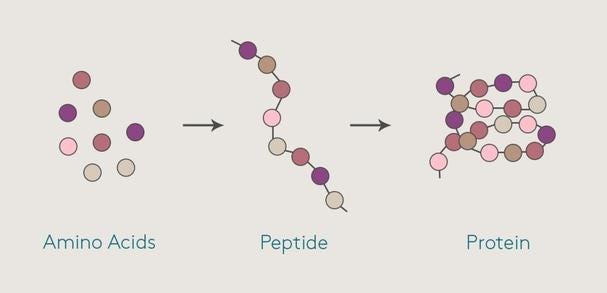
Creation is inherent in biology. The creativity of life arises from three effects: selective pressure on a biosphere (evolutionary), interconnectedness within the biosphere (combinations of existing living things) and sufficient time. The substance that makes up life is largely simple: nucleic or amino acids, life’s building blocks, are largely made up of hydrogens, carbons, nitrogens and oxygens, with a sprinkling of sulfur, phosphorus and other elements. Just a few atoms, organized in determined ways, makes up all of life.
But from these simple building blocks, the magnitude of possible combinations approaches infinity! Take for example a smallish peptide (protein) made up of 200 amino acids (parts of a protein). To assemble all possible variations of amino acids (total number of individual sequences is 20200 ; 20 unique amino acids strung together in 200 possible ways) would require more time than all of living mass on earth to generate than the duration of the universe. This number is so grand when contrasted with the measly 1080 total atoms that exist in the universe. Yet with evolutionary selective pressure, in humans, there are less than a million unique proteins that are generated from roughly 20,000 genes. The possibilities for protein design far outnumber what life actually uses to create all diverse and complex beings, including humans. And even with extended time, we will barely scratch the surface of potential protein creations in the future.
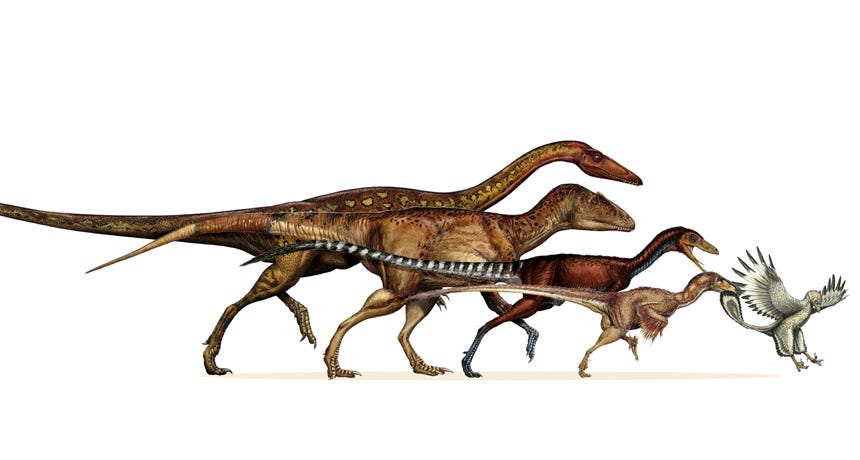
As a result, it is unknowable, what new tools or traits will emerge from the palette of life, ecosystems and biospheres. But emerge it will, acceleratingly. This is the argument of a provocative new theory called the adjacent possible (TAP)2. Stuart Kaufmann, one of the conceivers of TAP, is a theoretical biologist who asserts that our existing frameworks of mathematics, Newtonian physics and quantum mechanics are ill equipped to describe biological creation and creativity. Our sciences are confined to what is currently knowable and extant a priori. With the adjacent possible, traits and tools that aren’t yet realized in the physical world, do exist as possibilities, just out of reach. When they emerge or are created from the combination of existing artifacts (or through affordances)3, they will appear, in retrospect, obvious and intuitive; thus the term adjacent, or neighboring. A dinosaur does not immediately emerge from a single bacterium, but rather through a series of steps, a dinosaur’s thermoregulatory scales give rise to feathers which aid in flight.
For an example of adjacency, imagine a stick attached to a chunk of metal; you might have a hammer. A hammer can be used to construct an arrowhead. An arrowhead, while useful as part of an arrow, can also be morphed into a chisel. The chisel, which is used to remove material, can be crafted into a nail, which obversely tethers two things together, the way the idea of hammers and nails go hand in hand. And a hammer can be used as an ice pick, clock pendulum, piano music maker, exercise weight or as tool in Olympic sport.
The hammer is for a hammering

It never makes the world look as a nail,
As the proverb goes
Unless it strikes a string or three
Such that they resonate in a wooden box.
Sostenuto interfering with the initial impact
In a sepulchral coffin of sublime cacophony.
The hammer's claw is a fulcrum for the removal.
It corrects a mistake letting you know
That its presence is an apology to you
That it’s ok to err.

- Ben Wang, 2024
It is said regarding technology “we craft our tools and then our tools craft us.” Our human creativity is indeed part of the amalgam that gives rise to the adjacent possible. Creation begets creativity, unendingly, and all that is required is a cocktail of interaction, attraction, cooperation, connection and intersection.
If you have a quarter of an hour, watch him explain TAP for himself:
If you didn’t watch this, here is a TL;DR and my bullet points:
We are living in an anthropologically interesting time: TAP argues that it has always been interesting, as we’ve moved from unicellular organisms to multicellular to quorums, over billions of years. But as humans, we have already experienced exponential acceleration in the past five hundred years (from the printing press to the internet); what will emerge in the next fifty may be even more breathtaking. This holds for biology, technology and the economy.
Don’t bother predicting about what will come. Yes, it’s a human instinct to imagine the future, but we are notoriously bad at accurately foretelling. For all those that argue that biology is a solved problem, that AI will solve all problems, recall the quote from the scientist Lord Kelvin in the 19th century, prior to the advent of Einstein’s theory of relativity, the development of quantum mechanics, string theory, systems biology, and more:
“There is nothing new to be discovered in physics now. All that remains is more and more precise measurement.”
And lastly, that the secret to healing our Earth lies in the adjacent possible of the fungi bacterial communities, compost, ecosystems that make up the soil of our earth.
Answer: we are not machines, we are living and creative
Kaufmann has company for his way of thinking. Stephen Wolfram’s New Kind of Science argues for complexity emerging from simple interacting computations. Lee Cronin’s assembly theory describes the combinatorial and evolutionary selection of molecules and chemistry that builds upon itself. Philip Ball argues that we need new metaphors for life; we should stop referring to DNA as a blueprint, hard drive or some other inanimate information processing system. He writes, in his article, of life and its inherent…
“looseness, the permissiveness, pertains all the way up the scale – from molecules to networks to cells to tissues and bodies – in a manner that I call causal spreading. That’s to say, the true causes of outcomes at the level of traits and of health don’t all come from the bottom up, from the genes, but emerge at all levels in the hierarchy of scales. That’s how life works.”
Causal spreading sounds like realizing the adjacent possible. Life has rules, but it is this looseness, this uncertainty, that gives rise to the dramatically increasing richness of our biosphere that Kaufmann observes in TAP. It’s good to not know. Life not knowing is how we got here.
And maybe that’s the story of life. It’s messy. It’s unpredictable. Because that’s what a a dash or a pinch of this ingredient is needed to sustain creativity.
Life is full of living possibilities, enticing and mostly safe, otherwise there would be no life. We humans are life. What paths lay before us?
Let’s ask one final question and it is not to ask the world if it’s safe, living and enticing, but rather ask this:
How are you going to manifest the adjacent possibilities, of your life?
This is what Kevin, Erik and I named Svaya after, the Sanskrit for self-manifestation.
This is above my pay grade but there are philosophical consitency critiques of TAP and link to them here Philosophical holes in Adjacent Possible Theory
Affordances are “opportunities” provided by the system for an artifact to create a new use. Kaufmann states “the possible use of X to accomplish Y