
#65C - Grimoire
Part 3 on leaders. Books, turnaround and leadership lessons from James Daunt, head of Daunt Books, Waterstones and Barnes & Noble.

A faith in the world’s enchantments
solicits, from us, a requisite resignation.
At least that was what Silentio may have written
as unbounded commitment to finite evolution.
A grimoire is written in licit contradictions
once the universal is put to particular pen
the words that anchor to a numinous illusion
casts a joy over our minds in unrealized fiction.
- Ben Wang, 2026
A grimoire is a magical tome, a book of incantations written in arcane symbols, sigils and glyphs. Across the domains of fantasy, being literate in these spell books gave the possessor power limited only by their imaginations: abilities to summon fire and lightning, to rescue the mortally wounded, to levitate, to flee from invading goblins or to manipulate others with hypnosis and illusion.
These powers to enchant, prestidigitate and conjure, and their books, are found in our world too. We anoint them something else. Fire and lighting? Those are our science and engineering textbooks on electricity, magnetism and thermodynamics. Necromancy and rescuing the mortally wounded? Healing and cures are well documented in the tomes of medicine, anatomy and wellness. And levitation is travel, psychology is mesmerism and so forth. Poetry is the most beguiling of all, for its ability to sculpt language to meaning in the corners of our hearts. The farthest reaches of our imaginations, for as fanciful as they aspire to be, remain planted in our very real, lived experiences.
I wasn’t an avid reader as a youth until I discovered the fantasy genre. And I loved reading a particular author, Piers Anthony. He was a little cheesy and a little cringe, in retrospect, because he wrote explicit romance into his books, different than the mere hack-n-slash of his contemporaries, a precursor to the romantasy genre of today, perhaps. But his tales were full of adventure, humor, suspense and, well, magic.
And though his books were hardly literary, many of the fantasy worlds he created required language: making the magic required words.
Across fantasy, intoning properly is often the key that unlocks and harnesses sorcery. And beware, incantation errors lead to thaumaturgic failure, often to abysmally comedic effect, depending on the author or game master. Because even in fantasy, magic must have its own physics and obey its own internals set of logic and limitations. If magic endows omnipotence then nothing has meaning, some aporia about an immovable objects and unstoppable forces.
But I am grateful that it appealed to a sixth grade version of me, adolescent yet curious about possibilities in words; because Anthony often constructed the magic of his world in language. The world in his Xanth series was built on puns: the Isle of View is where love bloomed, where tulips tried to kiss you and an egress is a large female bird which carried you away as a means of escape. His Apprentice Adept series required spells to be cast in rhyme (Freeze Please to bind someone in place). The spells, once used were spent; repeating an effect required a new rhyme (I asked you to be nice, so stay still as ice), begging the reader to invent language, insisting in a groundwork for word play.
Piers Anthony showed me that words are powerful, that books are powerful. They entertain, they liberate, they get you to think, to imagine and to feel. They hold magic inside.
The decline of reading, the library and the bookstore
Yet reading is on the decline, with less than half of US adults reading one book per year. It’s not for the lack of options, the irony being that Amazon has made virtually any and all books available at a prime day’s notice. Instead our attention has waned, fracked on 140 character rants and short form video content. We are losing abilities to navigate long form narrative and complex, intersectional and, sometimes, incongruent literature, even at institutions of higher education. When forced to regurgitate words as proof of reading, there is the option for easily generated, GPT-digested summaries.
The combination of Amazon’s dominance and the inundation of alternative forms of media consumption have led to the erosion of both public libraries and book stores. In the nineteen nineties, megastores like Border’s Books and Barnes & Noble teemed with customers browsing for gifts and offered a place for teens to loiter while awaiting a movie, or a spacious chair to while oneself away in a novel. At the time, it was these corporate behemoths that threatened independent bookstores, documented in the book, the Reluctant Capitalists, by Laura Miller. Their scale enabled a broader selection of titles along side leveraged pricing power to offer readers a richer, more diverse yet economic, reading experience.
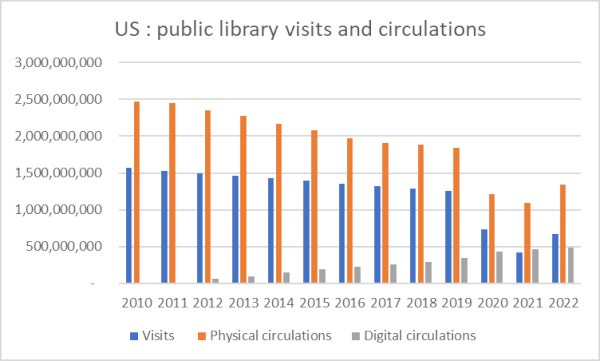
But scale, or rather the inability to do so in a competitively efficient market, turn Goliaths into Davids. Amazon bested the brick and mortars with nearly infinite selection, low inventory costs and, eventually, concentrated, monopolistic, algorithmic, strong armed buyer power. Barnes & Noble outlasted Borders, which went out of business in 2011, acquiring its assets. Yet it too floundered for a strategy to co-exist with the internet giant. It employed the tools of strategy: trimming titles, taking bribes from publishers for shelf space, hollowing out staff and sanitizing stores for efficient sales. It infamously flailed in launching its own E-reader, a punchline that happened to be named the Nook, a niche competitor to Amazon’s Kindle. And customers stopped going to the stores.
Enter James Daunt
James Daunt is a self-contrast, his manners an understatement. Check out his LinkedIn profile, as of December 2025:
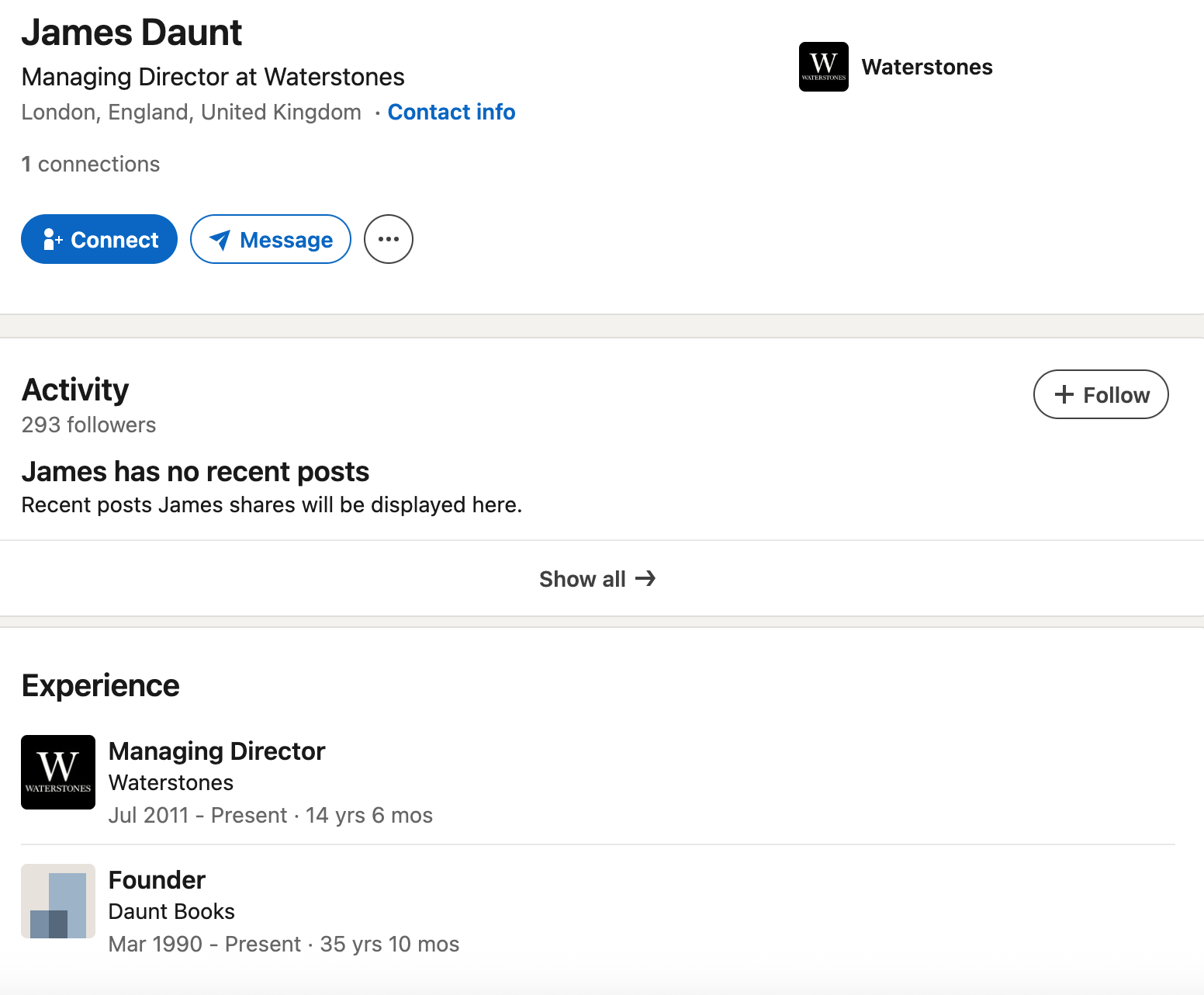
It appears he has no taste for his own self promotion, though he is a knighted Commander of the Order of the British Empire. But what he does promote is an avaricious love of books. A graduate of Cambridge University, he began his career with three years in finance and banking before growing dreadfully bored and leaving to start his eponymous book store, Daunt Books, in 1990. In contrast to his spartan LinkedIn page, look at the luscious herringbone floors, natural lighting and cozy reading nooks of the Flagship Marylebone book store:


Of the career shift he was quoted in late 2025 by Modern Retail:
I wanted to set up a business of my own as closely aligned as possible to my personal interests, … Reading topped these and, therefore, a bookstore seemed a good fit.
In 1990, under the backdrop of a recession, Daunt must have faced significant skepticism at his chosen venture. After all, the idea of owning an independent bookstore, without any differentiation of scale or technology, would be lumped together with prospects of owning a restaurant: both being money losing vanity projects. But Daunt was undeterred, believing in his objective:
to make the bookstore as interesting and attractive as possible, and have within it friendly, informed booksellers who enjoyed their customers and their jobs
Simple indeed and yet he noticed that:
This shouldn’t be distinctively different from most bookstores, but it was.
James Daunt used his bookstore as a playground, experimental lab and classroom in the business of book selling. It was there that he developed several key tenets for the successful operation of what he considered to be a relatively easy retail business.
“Frankly, you can be the worst retailer in the world and do quite well in books; everything was set up for it to succeed,” Daunt said, noting that books don’t have a short shelf life and that retailers can return books back to publishers for full credit.
“You just needed to turn the principles that were undermining the chain booksellers [around], and it could succeed.”
He believed that bookstore needed to reflect his own care for books. Above all, he created a space for and about honoring books, where if book lovers could gather, customers and employees alike, the business could flourish. He learned that empowering employees, giving them agency over the look of the store, choices over book stock, recommendations and even pricing led to greater engagement with potential buyers. When an employee was passionate about a particular book and wanted to offer it to the world, sales would climb.
In a world of authenticity, James’ transparent adoration of books was hungered for by his customers. The books were central. Here he was, a bookseller quoted, on the Fixable podcast, as saying:
I love the trade and I love the fact that bookshops, they're not remotely as important as libraries, but they are nonetheless important.
Since its founding thirty five years prior, Daunt Books has grown to a modest ten stores, weathering economic stresses, the looming competitive threats of Amazon, as well as comparable loss in interest in reading for pleasure in the UK. Along the way he built a loyal following through its bespoke literary ecosystem, hosting author talks, sponsoring short story competitions by children, designing collectible tote bags, offering commercial and private library building services and running its own publishing services.
Called up to the Bigs: Waterstones and Barnes & Noble
He did this despite picking up a couple side jobs along the way. In 2011 the UK based bookstore chain, Waterstones, with its some three hundred odd store fronts was acquired out of bankruptcy by the Russian billionaire, Alex Mamut, for around 60 million pounds. Waterstones, like other major chains, had struggled to adapt to online competition and shifting reading habits of consumers and became unprofitable. Mamut appointed Daunt to lead a turnaround by focusing on Daunt’s “central thesis: If he ran each individual store well, they could succeed.”
There he learned that patience was key. After six years, in 2017, Waterstones returned to profitability. In 2018, the bookseller was valued at $250 million, when an investment firm, Elliott Advisors, acquired a majority stake, retaining Daunt as the CEO. Today Waterstones does roughly half a billion pounds in revenue, earning about 30 million pounds in 2024. Even with a modest market valuation (price to earnings ratio of 12) the company’s worth has more than sextupled under Daunt’s leadership. Of lessons learned from Waterstones he said:
It's a little difficult, in fact, to turn around bigger businesses. You have to be extremely patient and go at the pace that everybody can understand and adapt to. But if you just keep at it and remain patient, you can change cultures. And ultimately, if you trust people and let people get on with, in our case, running decent bookshops, it'll come good. It won't be linear, but you will be fine in the end.
The paradox of his leadership magic, is that none of it is magic. He flattened hierarchies, empowered the people as custodians of books at the stores and trusted in the enchantment of a good bookshop.
I was running a very good book store and knew, and could evidently see it, every single day, that a nice bookshop is a pure pleasure to people. And knowing that's also true in almost every single community where one is lucky enough to be able to have a bookshop.
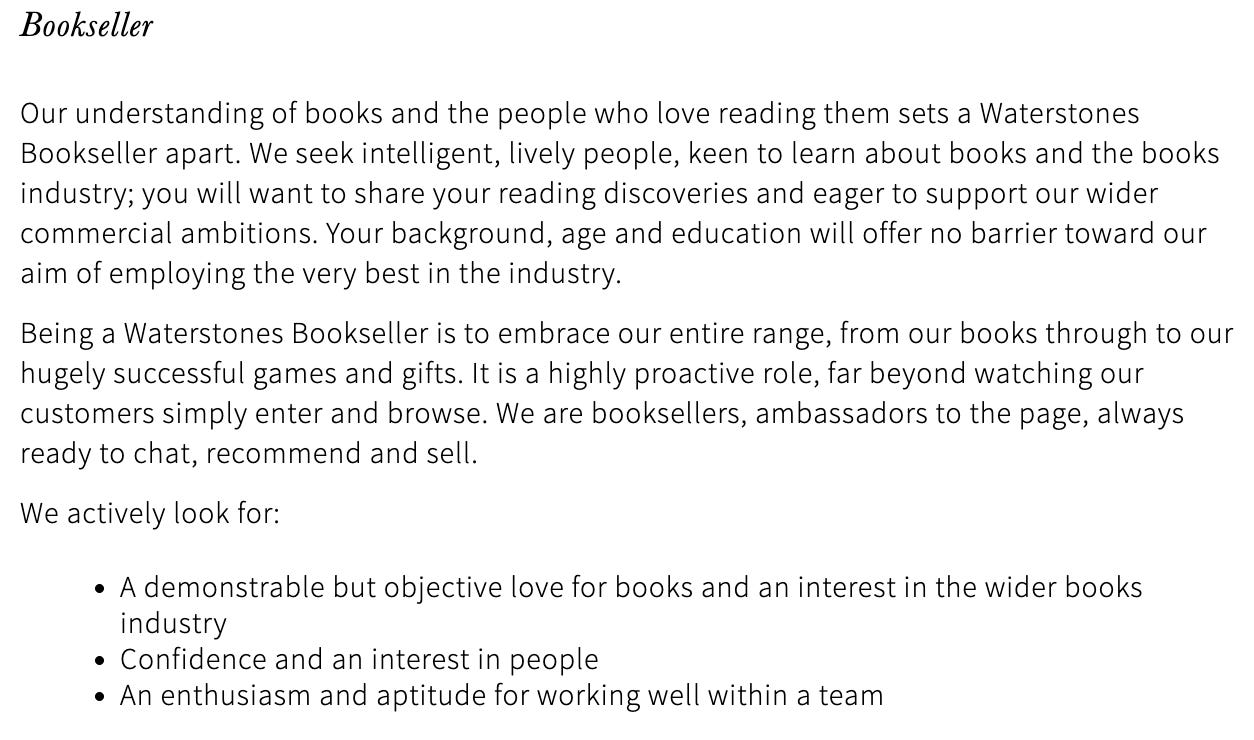
To wit, the key requirements to work at Waterstones as a bookseller, the official title, are books, people and enthusiasm:
And like at Daunt books, a literary ecosystem unfurled from Waterstones with awards handed out for fiction debuts, children’s stories and a book of the year. And with these prizes came gravitas and subsequent opportunities. In 2020, Maggie O’Farrell won the book of the year prize for Hamnet, now adapted into a major motion picture. Under Daunt’s leadership, Waterstones was financially, culturally and authentically revived.
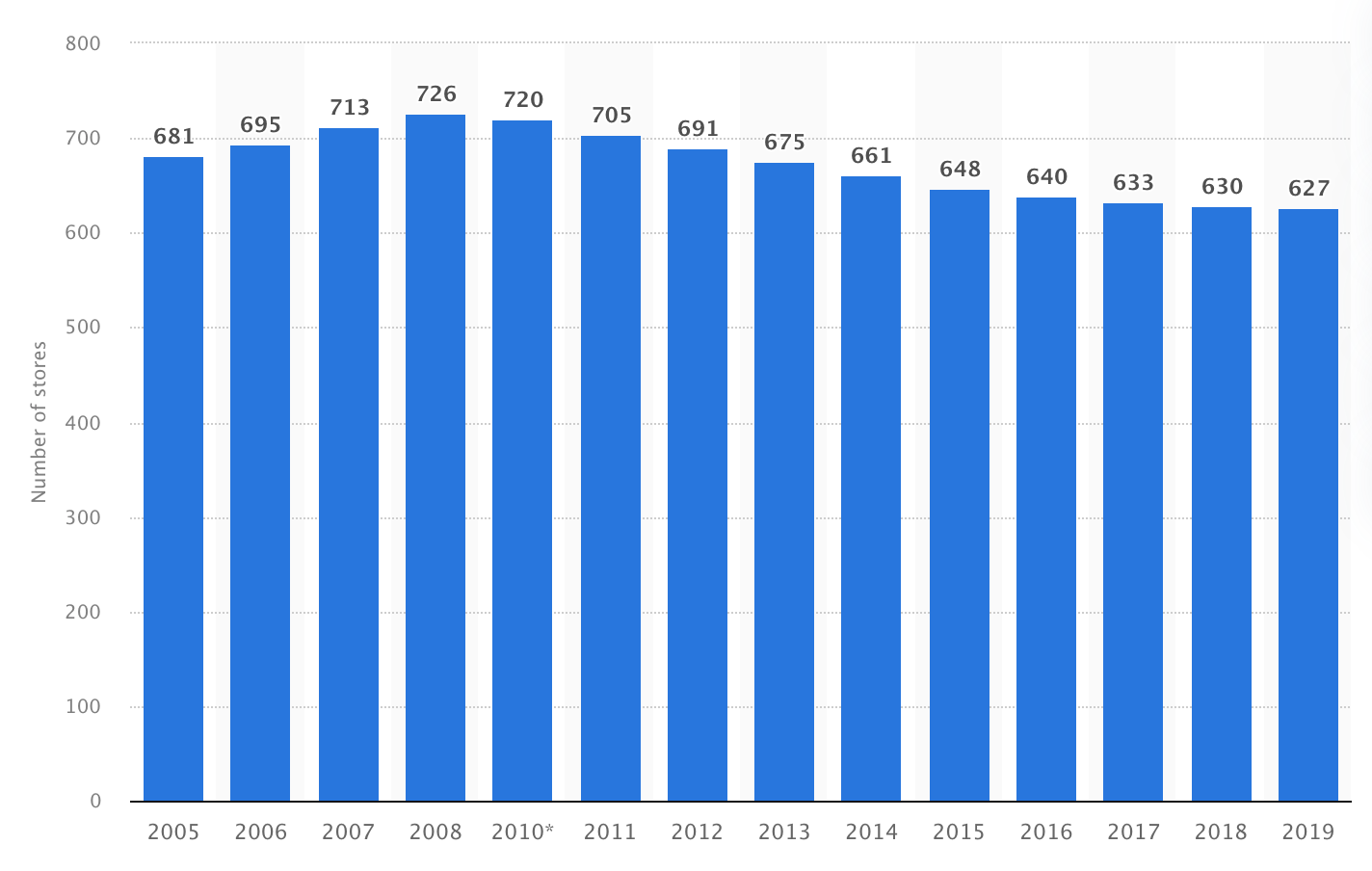
In 2019, with Waterstones on stable footing, Elliot doubled-down its bet on bibliopoles and expanded its empire, acquiring Barnes & Noble for almost $700 million. Steering Barnes & Noble was added to Daunt’s responsibilities, leading him to relocate to New York. Like Waterstones before it, Barnes & Noble had been struggling. When Daunt took over, Barnes & Noble was still profitable, earning about $40 million in 2019, comparable to what Waterstones is doing today in 2025. But they required revenue of over $3.5 billion to do so, making them roughly seven times less profitable than Waterstones. Barnes & Noble locations had shrunk to 627, from a peak of 726 in 2008.
Though less familiar with US consumers and facing a larger scale challenge than resurrecting Waterstones, Daunt added some moves to his playbook on turnarounds. By then he knew that, at heart, a bookstore was not a retailer that sold books, but rather people and a place that celebrated books that happened to have retail sales. He eschewed the industry standard agreements with publishers, those to reserve premium shelf space for ordained titles in exchange for steep discounts, even if customers weren’t clamoring for them. Daunt refused to dumb down Barnes & Noble’s offerings1. He cared about his people and provided paths for employee growth by promoting from within and doubling the number of full time workers to enhance employee stability which solidifying the necessary continuity required for the organization’s cultural shift.
And for Daunt sometimes less was more. He eliminated corporate middle management positions not involved in the act of book selling, simultaneously shoring up finances while centering leadership at the local stores. He accepted the defined role of large chain booksellers within the ecosystem, arguing that both independent bookstores and Amazon provided important services too. Of independent bookstores he says:
the smart places and the leafy middle class, the university towns, and they will have their independents that will gradually replace the big guys and that will be fine.
Of Amazon he argued:
I always felt that they were, probably gonna help book ownership, expand book ownership, which I do think has happened. They are fabulous in selling all the boring books, so we don’t have to have them in our bookstores. ‘Cause we used to. Even I had to have just the most tedious books [e.g. manuals] on my shelves imaginable because people kept on coming in and asking for them.
And like Brian Niccol’s vision of reasserting Starbucks as the quintessential third-space, James Daunt saw the value of physical:
bookstores that people wanted to spend time in. So we created what we call rooms… Which makes browsing much more enjoyable and also puts, allows customers to navigate the shops in a more intuitive way and different customer groups can enjoy themselves.
But whereas Niccol continues to face backlash for his command and control leadership style, alongside the tepid performance of Starbuck’s stock price, Daunt’s conductor like orchestration of autonomy at Barnes & Noble, like at Waterstones before it, appears to be paying off. Barnes & Noble remains a private company and, as such, does not disclose financial metrics. But it is returning to growth; they have added around 60 new stores in the last year, experimenting with location, size and layout to understand what works, and is expected to add 50 more this coming year. Elliot is rumored to be exploring an initial public offering for Waterstones and Barnes & Noble in 2026.
It helps that there has been a resurgence in independent book stores, here and in the UK. In our own little pocket of the Bay Area, boutique stores have emerged, like the newly opened Los Altos shop, a Novel Affair, which focuses on romance novels. My friend Chris Saccheri tends to Linden Tree Books as a rich garden for children’s literature, while pollinating to local schools to promulgate reading. Comic book stores are back on the rise. And of course Aidan H Stone has curated a poetic, cinematic, artistic, musical experience out of the used book store Feldman’s Books. A new generation of readers, who grew up on e-books, digital media and audiobooks are discovering IRL book stores, and their book sellers, for the first time.

But bookselling remains a tough business. Books Inc., the esteemed 170+ year old, independent, SF Bay Area book chain fell into bankruptcy in early 2025. But where one imagines tragedy another spots opportunity. In September, none other than Barnes & Noble tendered and offer to purchase Books Inc., choosing to allow the independent to continue to operate while preserving its identity and operations, supported with more robust resources.
In the modern world shaped by artificial intelligence, immediate gratification and technology enabled efficiencies, it is a wonder that a brick and mortar bookseller can not only continue to exist, but thrive with the patience of getting through Tolstoy. It does that by remembering that people attune to stories. That real human beings crave connection in mind, body and heart, that are found in books. And that stories, and the powerful grimoires they are found in, are adventurous, incredibly intimate, valuable and, yes, magical.
Daunt has mastered bookselling as a business. I doubt it was easy, but I imagine it was easeful for Daunt. Or at least fun, or meaningful. After his 35 years the takeaway is that the guy loves and cares for books and the people that read, write and collect them. Sprinkled in there is a manner of leadership that seems simple and driven by joy and kindness for people. Don’t be fooled, his method requires tremendous courage to face off against the cynical edicts of profit. To paraphrase Kierkegaard, the highest thing is to make an infinite commitment to a finite thing. In Daunt’s case, you might think it is undauntedly the business of books. You wouldn’t be wrong, but for Daunt, it is actually, simply the business of caring. What other industries might Daunt have equally impacted for the better and more profitable?
Hear from himself here:
Reading postscript
I read so much (trashy) fantasy in my youth that I forced myself to give it up after I turned twenty. But books have remained trusted companions. Steinbeck accompanied me during the lonely inception phases that preceded starting Chimera (East of Eden) and Svaya (Grapes of Wrath). Tomes have fueled connection through books clubs: my first was “textual exegesis”: with high school and college friends (where I was first introduced to Rilke through Malte Laurids Brigge). A nerdy Landau and Lifschitz’s physics series in grad school with Erik Allen, followed and Chimera’s workplace “Bookclurb” (Frankenstein, Pimp by Iceberg Slim, Heart of a Dog, Lolita) was popular. Boozy book club is rich in ribaldry, deep of dialectic and just plain fun. Of all, the strongest sorcery came from when books rescued me when I needed help to navigate grief.
If anyone has any great book recommendations, please hit me with them!
The excellent Ted Gioia, brother of the excellent poet Dana Gioia, wrote a highlight of Daunt a few years ago.