
#71 - The Immortal Memory
Don't procrastinate when you're preparing a speech! Also Billy McG!

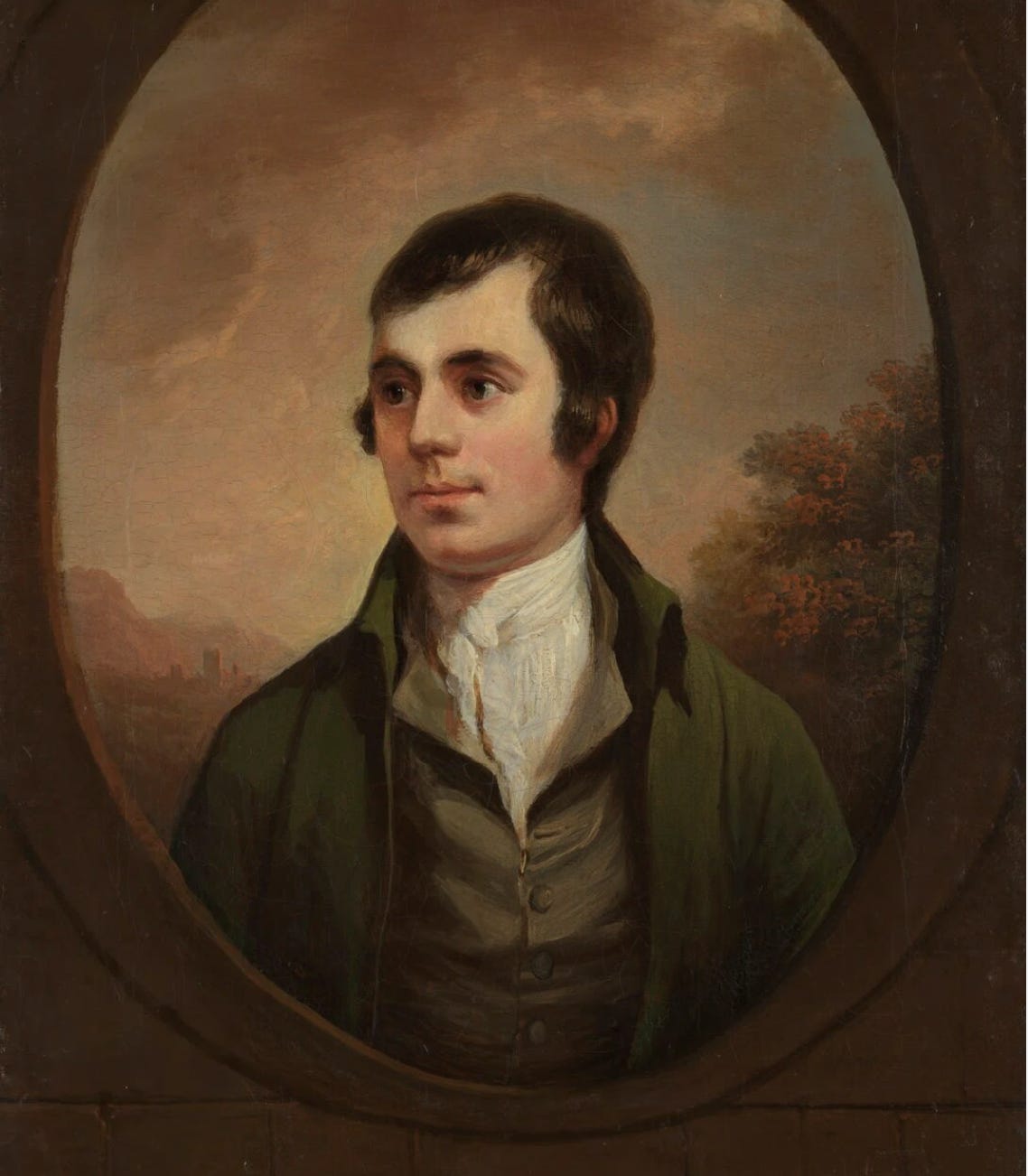
A January ago, I received an invitation to the “Atherton Burns Night” from my friend Gail. Reading the title, I briefly wondered if it were a pyromaniacal inflected, conflagrational “let’s burn Atherton down,” call to arms against the wealth inequality represented by the 94027 zip code. But I should’ve known better; Gail being a Glaswegian, the Burns reference was made to, instead, a celebration of Scotland’s most famous poet, Robert Burns.
Robert Burns was born on January 25th, 1759, destined to a life of labor and husbandry. Though he died at the young age of 37, without any formal education, he managed to pen some of the most recognizable string of words in the English language including “Of Mice and Men,” “Oh my love is like a red red rose,” “But to see her was to love her,” and “Auld Syne Lang” His words were stolen by Steinbeck, co-opted each perennial silvester by class of ‘91 SAMOHI alum, Carson Daly, and mimed by hard-up teenagers in the early 1990s (this may have been me).
William Butler Yeats once wrote: “When I consider the minds of … artists and emotional writers, I discover a like contrast.” For those, a silver tongue breathes words aloft. But a cladded spirit sinks under the weight of the burnish of its own rust. Burn was described often as a deep contradiction. He was what, contemporary and present, society might consider a deeply flawed person: philanderer, lustful, disloyal, gluttonous and over indulgent in drink. But he was also a lyrical Mozart, who threaded together simple vernacular into timeless sonatas, often in the Scottish brogue. He also advocated contumaciously against slavery, the hypocrisy of the Kirk (church) and monarchal rule, cheering on the American and French revolutions and individual freedoms.
Burns feels like an anachronism in the modern world that prizes outcome over values, min/maxing versus subtlety and narrow certainty over a broad discernment; perfection, striving and victory are the standard bearers of the current system. But remembering Burns harkens back to the a more fundamental truth of what it is to be human: simultaneously flawed and kind, aspirational and unproductive, licentious and grounded. Fortunately we have the Scottish tradition of celebrating these tensions with an annual homage to Mr. conflicted himself, Rabbie Burns, each January. And I am so grateful that Gail and Tim invited me to theirs now for the second year.
Burns Supper
The Burns supper is a formal affair. Dress tends towards suit and tie with tartan encouraged and kilts revered. The fare is Scottish and often traditional; Haggis is served (there is vegetarian variant) alongside tatties and neeps (potatoes and turnips) and, of course, uisge-beatha na h-Alba (whiskey).
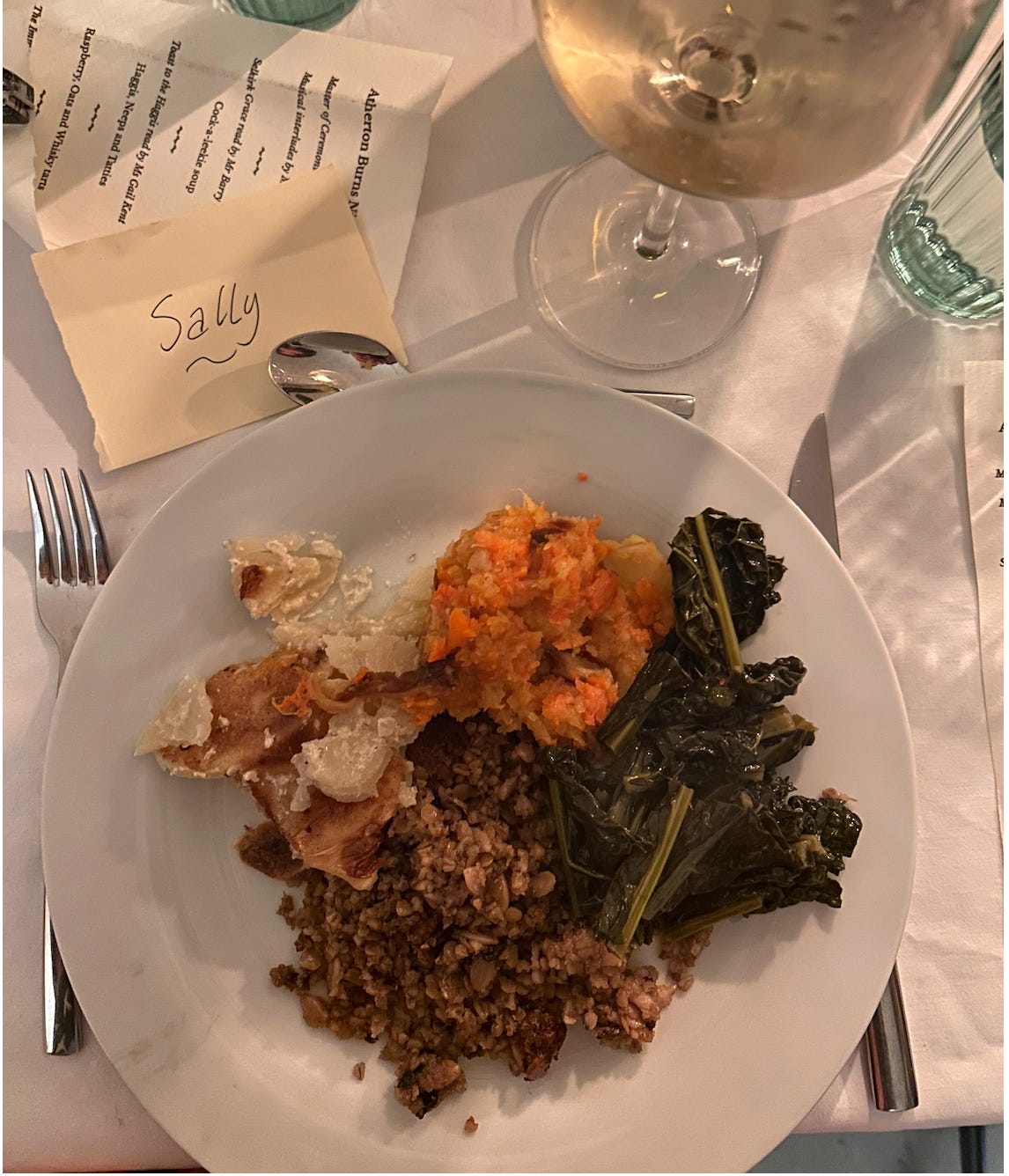
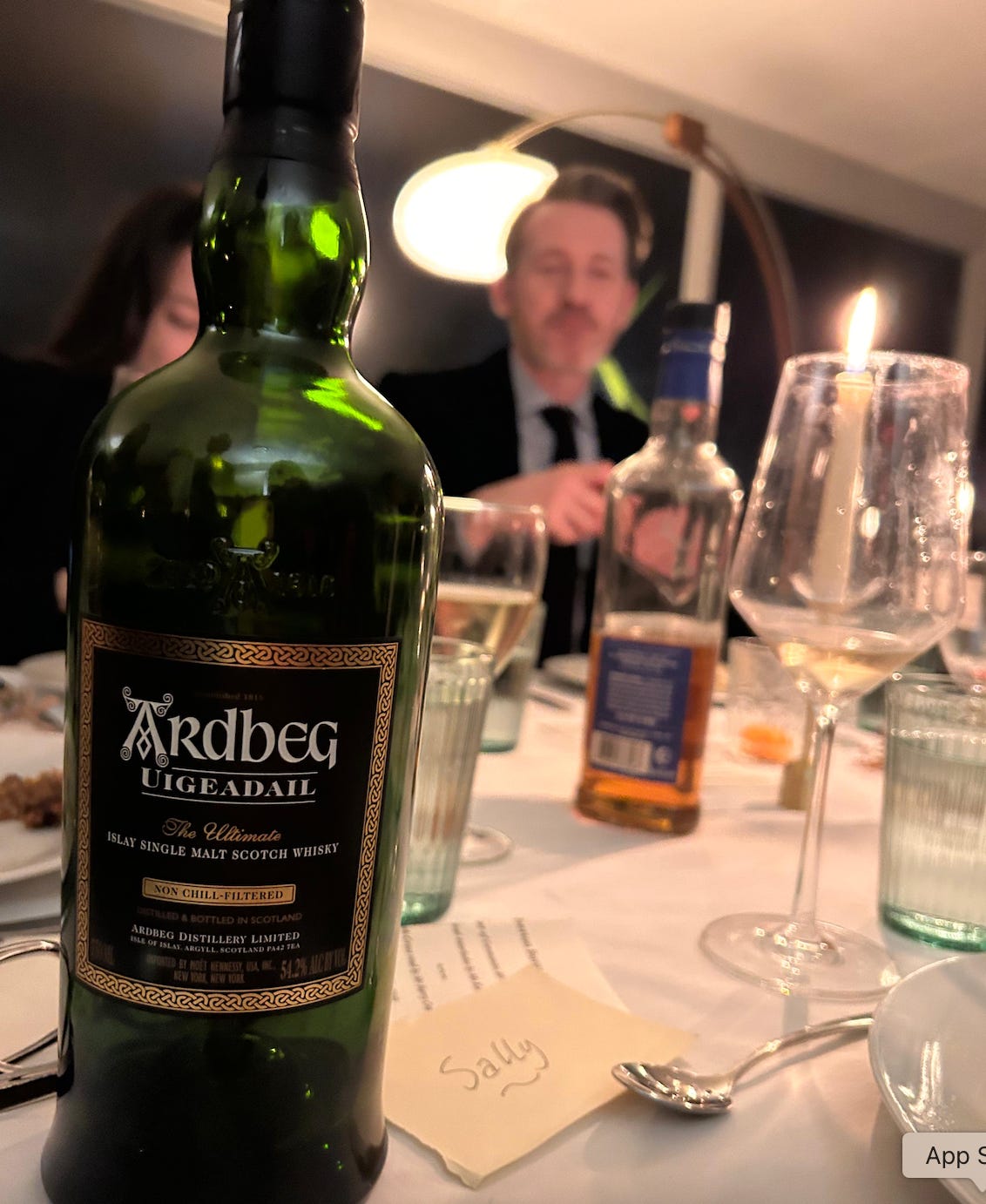
But the best part is the recitation of a specific set of speeches. Attendees are typically selected beforehand to prepare, put to memory and perform six speeches in order: the hosts’ welcome, the Selkirk Grace, the Toast to the Haggis, the Immortal Memory, the Toast to the Lassies and the Reply from the Lassies. The Grace and Haggis are orations of Burns’ words. I did the Selkirk Grace last year which goes:
Some hae meat and canna eat,
And some wad eat that want it,
But we hae meat and we can eat,
Sae let the Lord be Thankit!
Seemingly straightforward, with twenty words, it was all my simple mind could take not to butcher the pronunciation. Gail gave me an easy task last year but enlisted me into the greater labor of giving the Immortal Memory for 2026.
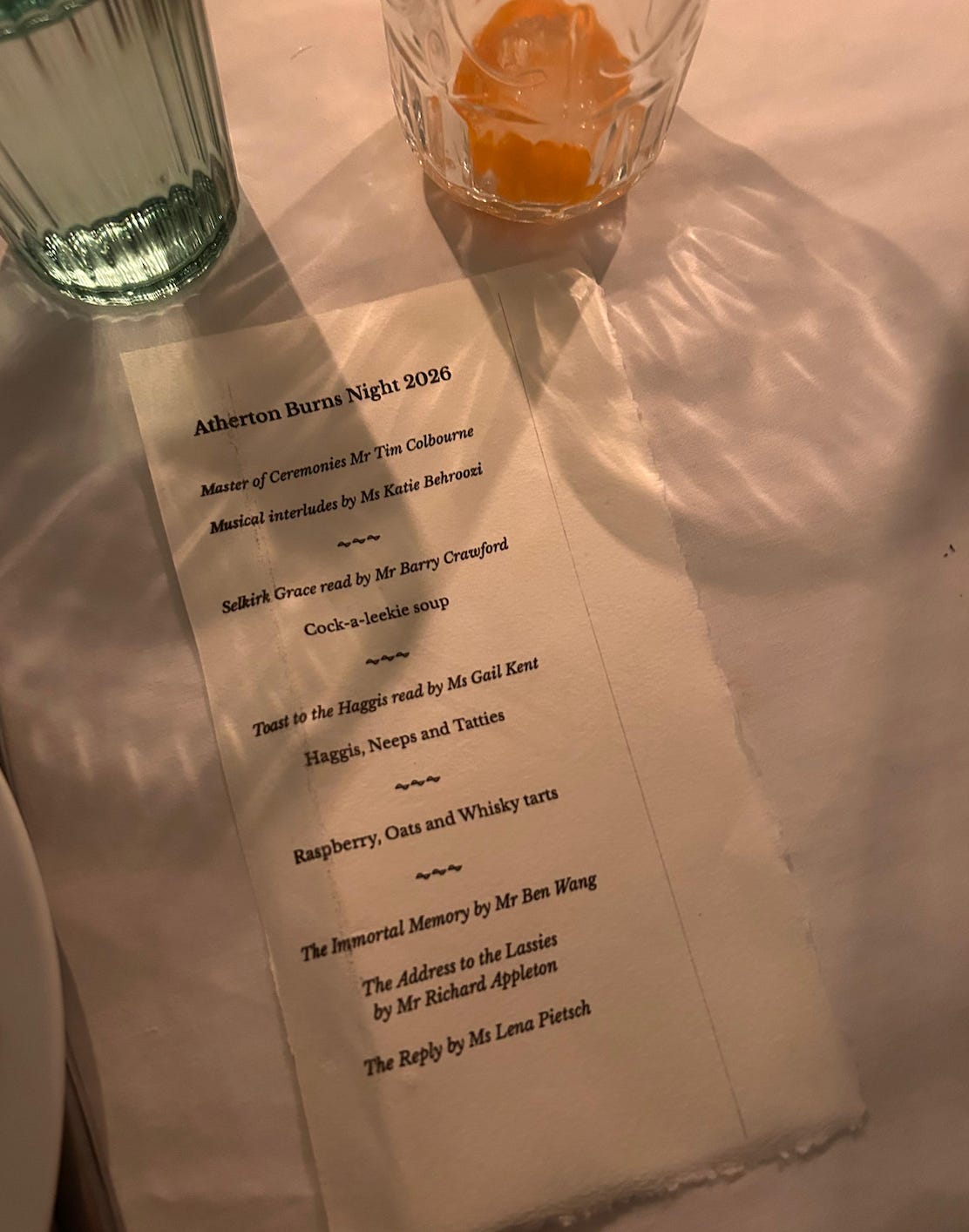
The Immortal Memory is considered the main meal of the Supper. The immortal memory honors Burns’ ideas, person and influence and extends them into different eras and circumstances. It is to be somewhat hagiographic while still adorned in wit and salaciousness and make frequent innuendos to Burns’ fondness of fornication, so adeptly highlighted by Cat Hepburn’s speech in 2023.
But as is my wont, I procrastinated until the day before the event to accrue some research for the speech. I had read some Burns, given that he was considered one of the forefather’s of European romanticism, but didn’t know much of his life or subsequent influence. Gratefully, and with a hint of ego knowing that I had frequently crafted, with Kerri Faber, last minute impromptu speeches for Happy Minute, I readied my speech with only hours to spare.
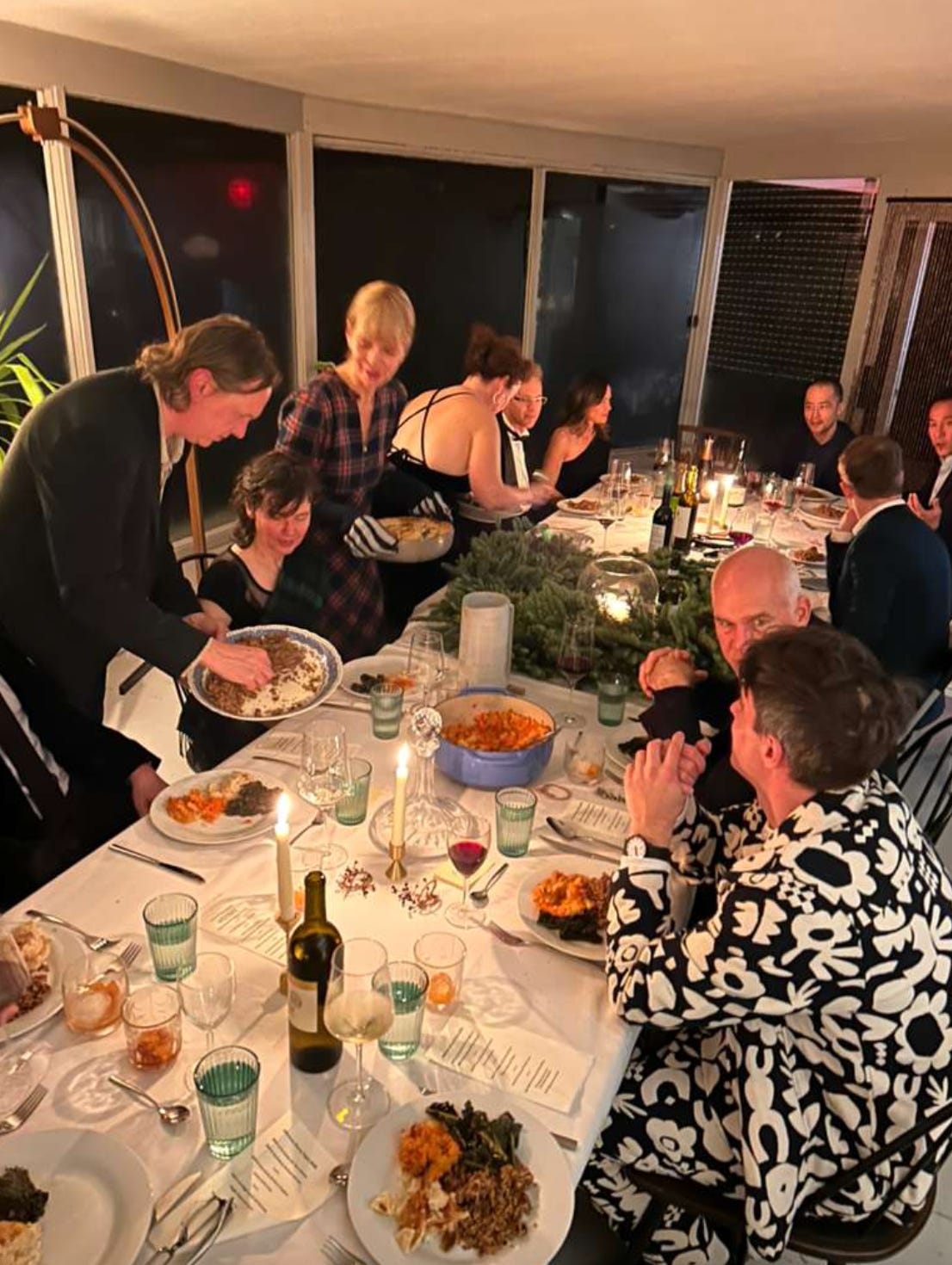
The supper was, at different times, a frivolous, fervent and friendly affair, with fond, familiar faces. With wine glasses filled and the whiskey poured, chatter of music, politics, gossip echoed across the room. Barry’s adept twenty six words of the Grace evoked gratitude and subsequent imbibing. Rob, a recent transplant to the bay area, recited the toast to the Haggis from memory, effortlessly and incandescently. Katie, my aunt Yeou-Cheng’s friend, and her violin took the place of a piper, whom I briefly accompanied with a droning A on Tim’s cello. The immortal memory was soon up.
I drew on my own experiences with Burns in my youth and my recent discoveries of Abraham Lincoln’s interest in his words. I wended Burns’ story into his needed presence in our current times fractured by war, iron-rule and division. I careened through a historical side door, lingering on Burns’ fondness for the lascivious, forcing Alex to remove his five year old son from the room. I was crescendoing towards my apical tribute to Burns, when Gail suddenly interrupted:
I’m sorry, did you just say William McGonagall? Scotland’s worst poet? That’s like having just spoken about Obama for ten minutes and then suddenly compared him to Sarah Palin.
Oops. I had referenced the work of William McGonagall in an unironic manner and had not thought much of it. Rob, as well a Scot, looked upon me too in jaw dropped disbelief. In my rush to finish my speech, I had found another Immortal Memory speech referencing the work of McGonagall and read in it:
As I recite these lines, I’d like you to remember that they are from the best known poem of Scotland’s second most popular poet.
See? He was Scotland’s second most popular poet! Yet, I was unfamiliar with him and jotted a few lines from the poem “The Tay Bridge Disaster” thinking to myself Huh, the lines seem clunky, but I’ll just assume there has got to be some reason why he’s popular.
What I didn’t notice were a few lines above where the author writes (in bold for emphasis):
… ask people to name another well-known Scottish poet. The name that most immediately comes to mind is William McGonagall, who is celebrated as the best-known bad poet in the history of literature written in English.
Or the line below:
Burns would undoubtedly have been bitterly upset at these frequent observations about the state of poetry in Scotland.
I think I singlehandedly threw any credibility, as a devotee of poetry, I had with Gail, under the proverbial bus. I must have blushed though I do think that the hallmark of a good speech is a good stumble and some laughter at one’s own expense. One can’t say they don’t learn something from the mistakes they make. The whole of my speech is below.
The toast and reply were excellently written and given by Rich and Lena. Rich dropped the mic with an incredibly tangible image of a modern Burnsian experience, with the phrase “Snogging at Costco.”
But the richest part of the evening was the company, the embodiment of gathering in community. The supper itself is a reflection of Burns’ own contradictions: the structural elements of the evening combined with loose fun creativity and connection. One could notice the same incongruities found in community; different perspectives, desires and hurts while joined together with a mutuality and a shared noetic experience. The traditions were lovely, the speeches provocative, the repast delectable, but the participants and our hosts most of all, were the reason for the joy. Thank you Tim and Gail for bringing us together in such a manner.
Let us end with a word for the wise! The take home message from anyone called to give a toast at a Burns Supper, in the future, two things: don’t procrastinate and whatever you do don’t memorialize William McGonagall!
My Immortal Memory Speech
Fornication. I’m sorry excuse my pronunciation. It’s the whiskey, allow me to enunciate. For an occasion such as this…
It is with great honor and trepidation that I share with you some brief words on the immortal memory of Rabbie Burns. Some of you may know that Robert Burns was suspected to be the favorite poet of Abraham Lincoln. Clearly Burns’ influence travelled quickly and widely all the way to the ears of a future US president growing up in a log cabin in Kentucky.
In fact when I was asked to give the immortal toast I delved into some research. And I found that Lincoln too was requested to offer a toast at a similar event, [yes I’m comparing myself to the greatest president of the United States]. I thought I might surreptitiously plagiarize the sixteenth president’s words on the poet, only to disappointedly find only a cursory, albeit profound, rejoinder.
Lincoln said “I cannot frame a toast to Burns. I can say nothing worth saying. ... I can say nothing of his generous heart, and transcendent genius" That’s it? C’mon Abe, you saved this nation and came up with the Gettysburg Address on the Fly! C’mon man - you couldn’t come up with three more minutes?
So I guess I’m stuck with crafting a few more words.
Robert Burns is of course the famed Poet of Scotland, its national poet. His penned words accompany many songs and airs. I learned that Joseph Haydn and Beethoven set many of these to their own musical arrangements. He was father of European poetic romanticism which held sway for a century and a half until Rilke brought forth modernism.
But for me it was his poetry. I aped his famous ones early, as Ban can attest to, in “romantic” letters I wrote in teenage limerence, to many a youthful crush. I would, and probably like many other love sick adolescents, scrawl:
O my Luve is like a red, red rose
That’s newly sprung in June;
O my Luve is like the melody
That’s sweetly played in tune.
And despite Burns elocution, this failed to work, especially with the orchestra girls.
But I was not the only one who was inspired. Burns was inspiration for Shelley, Tennyson, Wordsworth and other greats. He was famously an autodidact, fierce advocate for political democracy, rabble rouser and most notably a lascivious lover, his romantic proclivities perhaps the most often thought of his historical aspect. His sexual tendencies are probably why the name Burns remains such a powerfully prurient namesake. That libidinous namesake that even appears among us tonight. Right? Isn’t that right Mr. Burns. Mr Tim Colbourne…s.
But we are gathered together tonight not merely for debauchery and find ourselves in the sesquicentennial year of this democratic experiment of the United States, an ocean of time away from Burns’ own land. Some might say today is not unlike the Lincoln’s time - at odds from within, neighbor against neighbor, vitriol spilt in words. But like then, Burns influence, thinking and his honesty perhaps hold sway today here as well. In this time, this land feels sundered by what surely he would consider to be false divisions - of the politic, of the economic and of the spiritual. He ask us to wary of this in his invocation towards equality, in his humble poetic, “To a louse.” At risk of savagely butchering his, your, language, I will make no attempt to recite this and offer instead a modern take on Burns’ key ideas by a fellow poet, Rabbie Black who writes:
Oh, would some power, the giftie gi’e us,
Tae see ourselves as others see us.
It would from many a blunder free us,
An’ foolish notion.
Some think they’re weak. Some think they’re strong.
Some think they’re right. Some think they’re wrong.
Some think they know where they belong.
Such foolish notion?
Some sit at the front. Some sit at the back.
Some like tae be loved and some love back.
Some love and live wi’ a burnin’ fire.
And blind devotion.
Oh that we had the voice of Robert Burns in our times. What would he make of such gossip and dogma of our fearful cloying and sycophantic internal lives. He might say that we are in a recession of soul and the antidote is some trouble making, drink and song. That in our current and modern times we cleave to purity but mistakenly leave out the imperfect and contradictory that makes the very stuff of life.
After all Robert Burns was far from saint and he never claimed that he need be. Indeed he lived his life as closely as possible to the swath of human experience in which to err was to live, but ever to do so with a kind slant, justice and resilience. For he knew that the human condition was always one of uncertainty and that as a paragon of the Scots, knew that one would have to meet this with resolve. Keats called such a thing a negative capability, the ability to withstand the troubles of the unsure and unknowable. And Burns, in his lovely and resigned musings on a mouse, echoes this.
But Mouse, you are not alone,
In proving foresight may be vain:
The best-laid schemes of mice and men
Go oft awry,
And leave us nothing but grief and pain,
For promised joy!
Still you are blessed, compared with me!
The present only touches you:
But oh! I backward cast my eye,
On prospects dreary!
And forward, though I cannot see,
I guess and fear!
We might heed this Burnsian inheritance - of the words, of the poetry and of the spirit that infused them. That inheritance that begged a union from the fractured, that salved the harm with comfort and that made reason out of the chaos of our baser instincts. The same inheritance that aided Lincoln when a country warred from within. Now, as then and in the future, we need this inheritance once more. This same inheritance that passed on through his countrymen and his fellow poets until even1 Scotland’s second most known poet, William McGonagall wrote:
It must have been an awful sight,
To witness in the dusky moonlight,
Had they been supported on each side with buttresses,
At least many sensible men confesses,
For the stronger we our houses do build,
The less chance we have of being killed.
Burns immortal memory lives on because his is precisely the memory of what it is to be mortal. His timelessness accompanies us because he put to pen what indeed sings, carouses and rings within us. He lives on in all of us. To his immortal memory.
the “even” was changed post dictum because of my embarrassment!
I think I’ll go find some uisge for myself, and look up contumaciously!