
#32A - Fables in Community
A five minute conversation with poet, Elizabeth Biller Chapman. And a short reflection.

“Hello,” I entreated.
“Oh, I’m sorry, were you sitting here?” she startled back.
“No, not at all. I just loved the fact that you were willing to sit here at this table with a random stranger. We need more of that!”
My children’s grandmother, Doreen, visited, along with Kim’s older sister and her son. Doreen had grown up in New York and so, at the recommendation of my brother, we went to grab an “authentic New York bagel”1 at Boichik’s, in Palo Alto. We awaited our order when a woman decided to rest and sit at our table, noticing that two seats remained unoccupied. She was elegant and eased into the chair, with the assuredness of one who has been through a wide palette of life’s gifts and miseries.
It was a brief conversation, no more than five minutes in all, not unlike my appointment with John from PAMF. She explained that she was picking up a half dozen bagels for her daughter and their family, who lived in San Carlos; too distant for bagels of proper origin, apparently.
“Once a mother always a mother. And it’s the best job in the world.”
“Mothers are truly amazing,” I agreed.
I turned to Kim’s sister, Jess, and remarked that I had been writing about mothers as of late; Dianna and Sandra.
Our interloper leapt at this. “Oh you’re a writer!”
“I’m far from it. I’m an engineer but I write some random …”
“I’m a poet,” she interjected.
“I love poetry!”
In a three minute flurry we bantered about the role of poetry, missing in life today. I offered up some analytical regurgitation; something about carving words or erecting structure to the unsayable and unspeakable, as if I were some adolescent adorned in references to Proust or whiskey infused dysaffection2. She humored me, agreed with me, edified me. She then humbly said that she didn’t begin writing poetry until her mid-forties. I rejoined that I had taken a few classes on poetry in my youth, silently hoping that Christian Wiman, Dianne Middlebrook or even Robert Hass would keep me afloat. With the confidence of competence, she said:
“Oh I started off in community college, over at Foothill… “
Based on the thread of our conversation, I assumed she spent time raising her children before finding her vocation. I was wrong.
“Well I’ve got to go. You know, have to deliver the bagels and all. What’s your name?”
“My name is Ben Wang, there’s like a million of us, so you couldn’t possibly find me.”
“My name is Elizabeth Chapman. You can find me.”
“Elizabeth Chaplin?” thinking I had recognized the name.
“No, Chapman, M-A-N…”
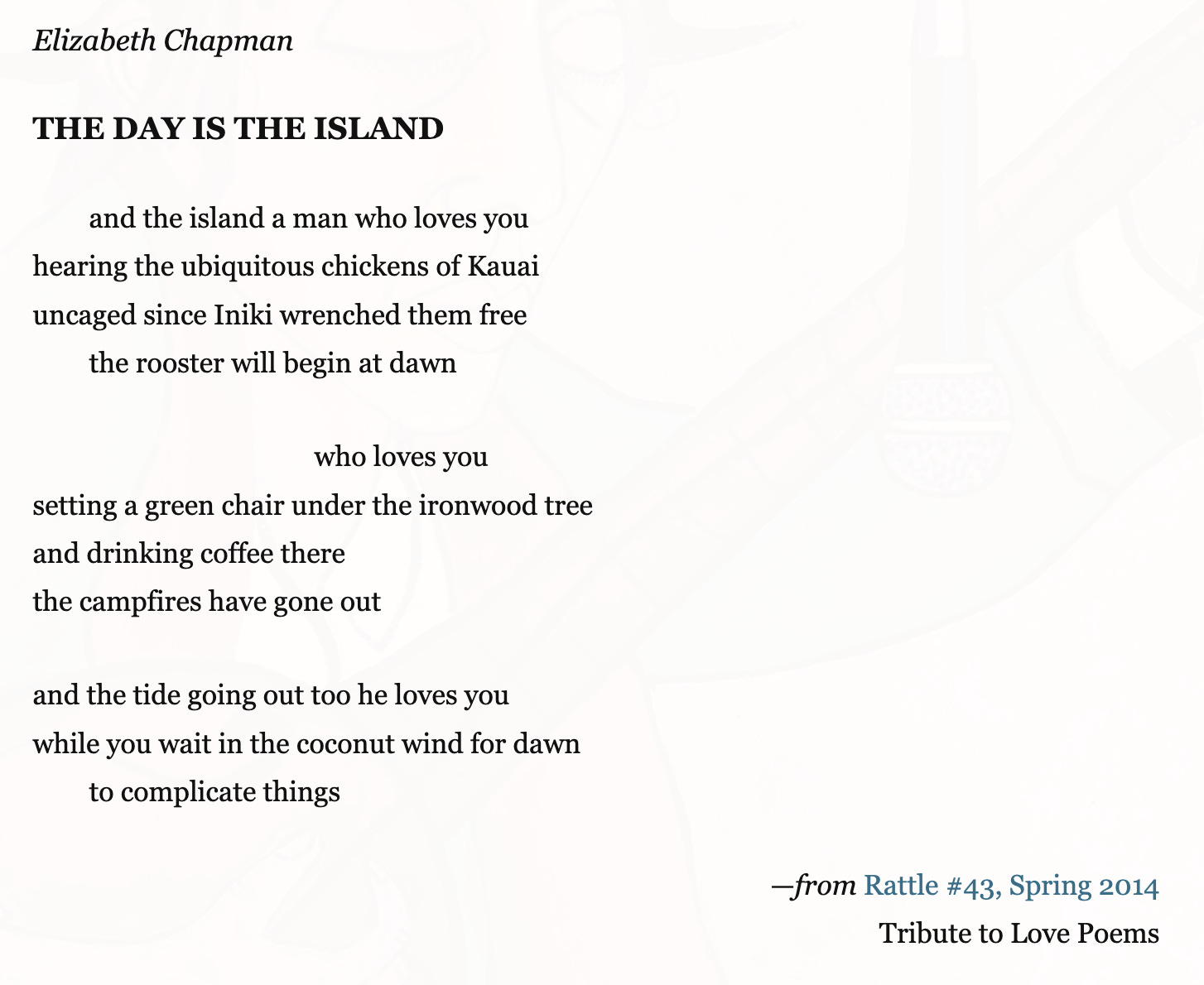
And, this was how I met the poet, Elizabeth Biller Chapman, this weekend. And this 81 year old girl got game.
Elizabeth Chapman
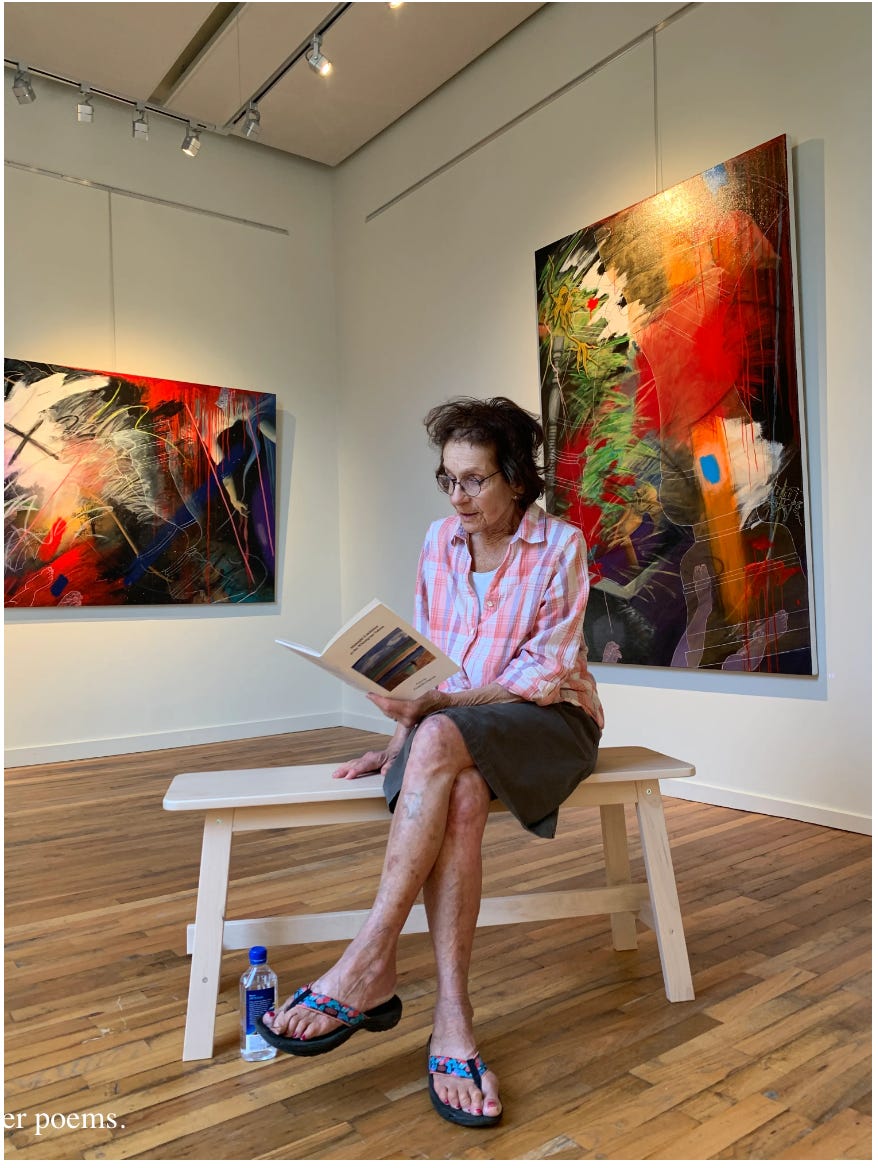
I did the internet dive and found little about her, except the poetry. She is a poet of no minor repute. Of her biography, I noticed there was not a single trace of the accent of her native Brookline, MA, a suburb of Boston, likely effaced from decades in California. Born in the same year as my mother, she studied at Smith College (where her mother studied), the Shakespeare Institute in the UK and followed those stints with a PhD at Columbia. She taught Renaissance era literature and built a private practice as a psychotherapist for two decades. Despite those enviable careers, it wasn’t until her fourth decade that she discovered her calling, noting, in retrospect, that she had “only two real vocations, mother and poet."
The license plate on her car reads “4POETRY”
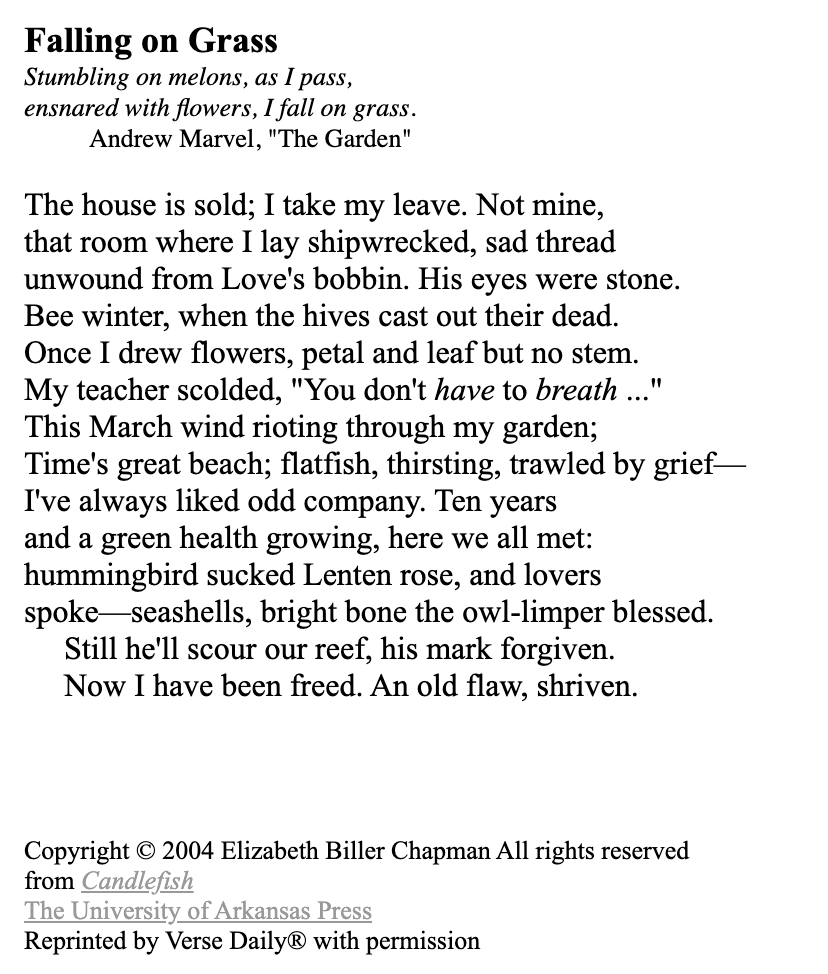
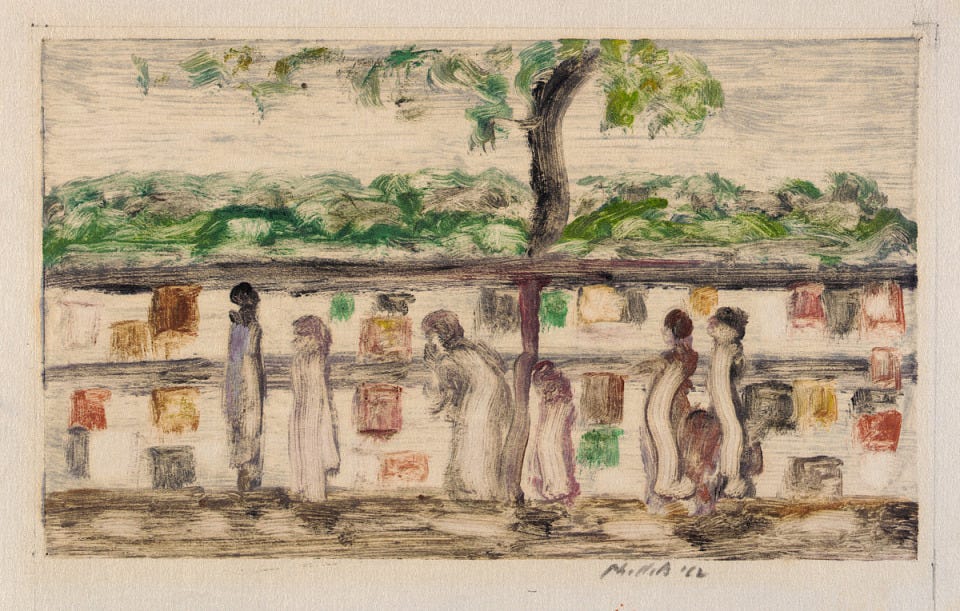
There was little else of her life that I could find, except for a minor breadcrumb; she had lost a partner Matt Phillips, a local, renowned Oakland artist. They last shared a joint poetry reading and art exhibition in Montana, before his death in 2017. Beyond these few facts, the whole of her existence of her to be found online, despite how much information is cataloged in our technology enabled time, was her literary canon. She was quite the digital ghost.
She left me with so many questions: what were the interleaving years of her life like? What does being a mother mean to her? What role does she see poetry having in the 21st century? Does she have a favorite soliloquy as a Shakespeare scholar? How did poetry find her halfway through her life? How does she view her becoming into poetry? Did her practice as therapist leave her with clues to her poems? What did she see as the tragedies and triumphs of her life?
In short, there is an infinitude of depth in another human being, a human being who is otherwise unremarkable to a passing stranger. As it relates to Elizabeth, some of those questions have been answered, but unsurprisingly, they have left me wondering for more; I’d love to know more deeply about this human being. Perhaps I’ll see her at the bagel shop again, some day.
Reflections on the five minute conversation
Adam Grant spoke of the power of a five minute favor. I’m just as astounded by the poignancy of a five minute conversation with a stranger. I assume that the brief chat we shared did not leave a comparable impact upon her, but I have learned to question that assumption. We are all made of a vastness. Human connection is an incredibly powerful elixir and shared passions can stitch the draught more tautly; knitting, after all, always requires two hands. But to connect, these conversations must go deeper, get to the roots of who we are and how we choose to see one another. This is a small gift of einfuhlung.
I am continuously convinced that poetry is an sanctifying concoction, best spoken aloud when cauldroned with others. I share this often with my friend Charlotte and together with my friends Stacey and Krista. Jen offers me the solace of Mary Oliver. Gus, one year, gifted me Robert Hass’ “Time and Materials,” as a birthday gift. Poetry is caritas and shouldn’t be inaccessible. Gratefully, there are poets who are trying to make it easier for everyone, highlighted during a recent hump meeting on this exact topic.
It is also a reminder to invoke the wisdom of the yes, with a nod to Foley and Dave who first introduced me to this concept from improv. We can choose a shyness to the world and demur with a no, the result of the introversion we discussed in #31A. I fear this resultant disconnection for its deleterious impact upon our children: whether it’s Freya India’s writing about the feeling of living in an “age of abandonment,” or the words of Andrew Solomon, in the New Yorker, describing how adults might choose to connect to the bereaved and aggrieved:
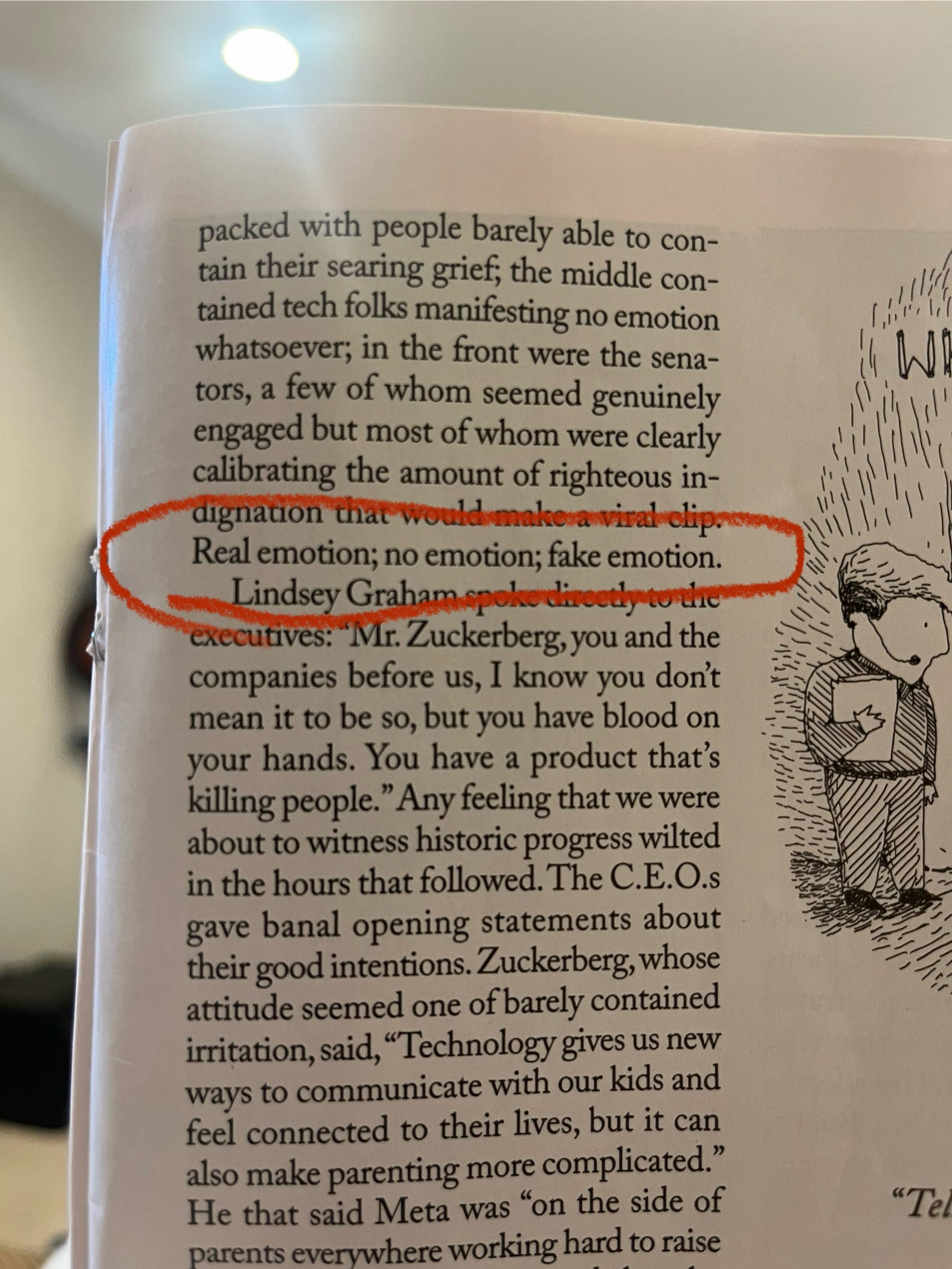
Or we can choose to be brave and accede to the offerings from our fellow temporary travelers on this big blue beautiful marble of ours. Yes, is an infinitude. Elizabeth was willing to give me a yes.
Who will be the recipient of your gift, a five minute conversation with you, an impossibly unique and wondrous human being?
I never know whether to trust my brother, or not, on opinions. I do not question their veracity, but whether they are formed from an authentic personal opinion or as a weighted average of others’ perspectives. He usually delivers on the quality though!
Ooh, let’s play with this neologism going forward.
And I love how boichik got you more than bagels that day.